
Introduction
Discover the world of Teradata, an industry-leading data warehouse and analytics platform that offers parallel query processing and several deployment options. This comprehensive blog post will explore Teradata’s key features and benefits, learn about its architecture, and discuss its significance in modern data-driven organizations.
Part of the Teradata Internals and Operations guide.
Stay tuned as we unlock the power of this robust data management solution.
Teradata Overview
Teradata is a high-performance, massively parallel processing (MPP) data warehouse solution that enables businesses to easily store, analyze, and manage large volumes of data. Its robust architecture, advanced query optimization techniques, and cutting-edge analytics capabilities make Teradata a popular choice for organizations seeking to gain valuable insights from their data and excel in today’s competitive landscape.
Teradata’s Key Features and Advantages
Dive into the core features of Teradata, including its MPP architecture, workload-dependent scalability, comprehensive data management capabilities, and advanced analytics tools. Explore how Teradata’s built-in support for Structured Query Language (SQL) simplifies data access and manipulation. Learn about the platform’s compatibility with various data types and formats, including Teradata date formats.
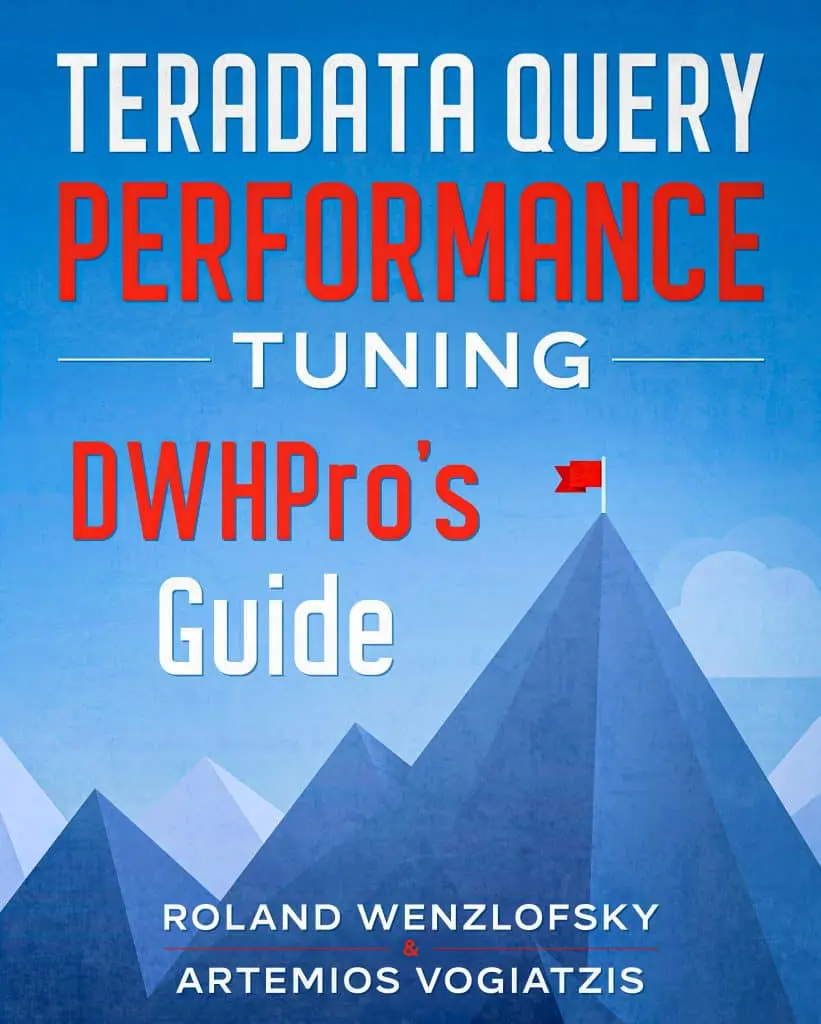
Get the complete Teradata tuning book, free
Teradata Query Performance Tuning: The DWHPro Guide
By Roland Wenzlofsky & Artemios Vogiatzis
206 pages on statistics and demographics, access paths and indexes, query execution plans, and joins. Get the full PDF and practical Teradata updates from DWHPro.
Confirm your email to receive your download link. Privacy policy. Unsubscribe in any newsletter.
About the free bookTeradata Architecture: The Backbone of Performance
Get an in-depth understanding of Teradata’s unique architecture, which combines a shared-nothing design with a parallel processing approach to support parallel processing and resource utilization. Learn about the critical components, such as the Parsing Engine, BYNET, and Access Module Processors (AMPs), and how they work together to execute distributed queries in Teradata data warehousing environments.
Teradata in Action: Real-world Use Cases and Success Stories
Typical evaluation workloads include financial reporting, customer analytics and large batch transformations. This overview does not supply independently measured customer case studies. For a platform decision, benchmark representative data, concurrency, latency and cost on a named deployment.
Getting Started with Teradata: Resources and Deployment Options
Start with the official documentation and confirm supported deployment options, client versions and operating requirements. Build a small representative workload, record its data volume and resource use, and compare candidate configurations before committing to capacity.
Conclusion
Teradata can support large analytical workloads. Suitability depends on measured requirements, operational skills and total cost; this overview makes no comparative performance guarantee.
MPP can increase capacity through parallelism, but speedup depends on skew, communication, I/O, concurrency and query design. Linear performance growth is not guaranteed by adding nodes.
Moreover, Teradata’s robust analytics tools empower businesses to extract actionable insights from complex data sets, facilitating data-driven decision-making. By leveraging these powerful tools, organizations can identify trends, patterns, and opportunities that may have otherwise remained hidden. This improved visibility into data enables businesses to make more informed decisions, optimize operations, and ultimately drive revenue growth.
Teradata also boasts a highly flexible and adaptable platform, supporting various data types, formats, and integrations with other data management and analytics solutions. This versatility makes it an ideal choice for organizations with diverse data requirements, as it can easily accommodate different data sources and workloads.
Furthermore, Teradata’s commitment to continuous innovation ensures its platform remains at the forefront of the data warehousing and analytics landscape. By investing in research and development, Teradata consistently delivers cutting-edge technologies and features that help organizations stay ahead of the curve in an ever-evolving data ecosystem.
In summary, Teradata has established itself as an indispensable tool for organizations serious about leveraging their data power. Its advanced architecture, powerful features, ease of use, and commitment to innovation make it an excellent choice for businesses seeking to unlock valuable insights and drive growth in an increasingly data-driven world. By embracing the potential of Teradata, organizations can elevate their data warehousing and analytics capabilities to new heights and thrive in a competitive landscape.
Visit the official Teradata website at the link below.
Deciding what to change in your data platform?
Compare optimisation, modernisation and migration against your workload and business requirements.
Get the complete Teradata tuning book, free
Teradata Query Performance Tuning: The DWHPro Guide
By Roland Wenzlofsky & Artemios Vogiatzis
206 pages on statistics and demographics, access paths and indexes, query execution plans, and joins. Get the full PDF and practical Teradata updates from DWHPro.
Confirm your email to receive your download link. Privacy policy. Unsubscribe in any newsletter.
About the free book