Teradata Join Strategies Explained in 6 Minutes (Video) Widely read
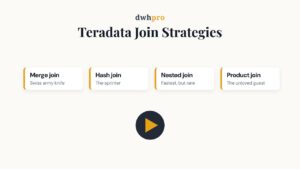
A six-minute video on how Teradata joins work: why matching rows must share an AMP, redistribution vs. duplication, and the merge, hash, nested and product join.
327 technical articles on Teradata, Snowflake, Databricks, SQL tuning and data warehouse architecture — written from production experience, not vendor decks.
A six-minute video on how Teradata joins work: why matching rows must share an AMP, redistribution vs. duplication, and the merge, hash, nested and product join.

Connecting an LLM to Teradata via MCP is easy. Building an efficient, secure, commercially sustainable enterprise solution is another matter. A practical guide to what buyers should evaluate.
Compare Snowflake and Databricks by workload, governance, complete cost and operating effort. Includes a practical proof-of-concept checklist.
Row counts, aggregates and hashes answer three different questions after a migration: whether all rows arrived, whether the business totals are the same, and whether every individual value is identical. Use them in that order and together, because each one catches errors the others miss, and none of them on its own proves that a …
A zero-downtime data-warehouse migration runs the old and new platforms in parallel, keeps the new one continuously synchronised, and moves users and downstream systems across in controlled steps with a tested way back. “Zero downtime” is a design goal, not a guarantee: it costs dual running, adds complexity, and in practice still needs short, planned …
Late-arriving data during a warehouse migration is handled by agreeing, per source, how late data may arrive, keeping a reprocessing window open on both old and new platforms, and reconciling by business date rather than load date. Most “mismatches” found in parallel runs are not migration errors but late records that landed on one platform …
Data lineage impact analysis before a warehouse migration traces every path from the source systems through the warehouse to the reports, extracts and applications that consume the data. It tells you, before anything moves, what each object feeds, who depends on it and what can be retired. That answer sets the migration scope, the order …
To estimate cloud storage and compute costs before a migration, start from your measured Teradata workload history, translate each workload group into the target platform’s billing model, and model several scenarios instead of one number. Add the storage factors Teradata never billed you for, such as data retention features, duplicate data during the parallel run …
Migration wave planning splits a large data warehouse into groups of workloads that can be moved, validated and switched off together, ordered by business value, dependencies and risk. A good wave plan lets you retire parts of the legacy platform early, learn from the first wave before the hard ones, and avoid a single big-bang …
When replacing legacy ETL tools during a cloud migration, each family of pipelines has three options: keep the existing tool and point it at the new platform, re-platform it onto the vendor’s cloud edition, or replace it with cloud-native transformation and ingestion services. The right choice depends on where the business logic lives, how many …
Follow DWHPro in Google to see our articles more often in Search.
We count visits without cookies and without storing anything on your device. With your permission, we also use Google Analytics for our Google Ads integration and remember which campaign brought you here. We do not record sessions. You can decline and still use the site. Privacy details.
Protected by Security by CleanTalk and CleanTalk Anti-Spam