
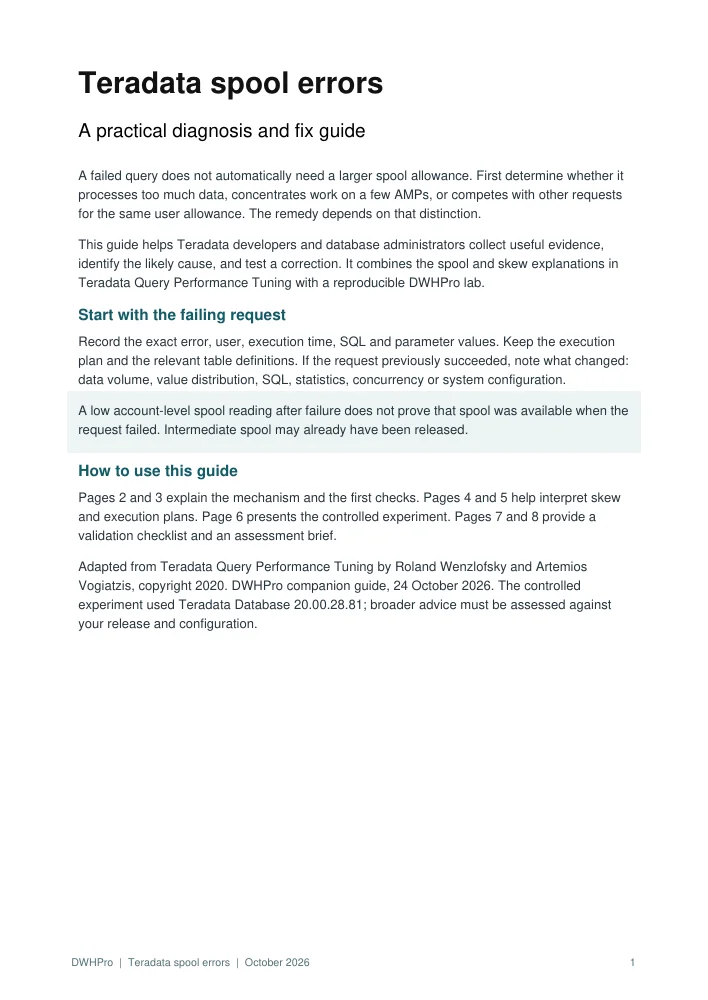
Diagnose spool errors before increasing the allowance.
A free, eight-page guide for Teradata developers and DBAs. Work through account limits, skew, execution plans and shared-user demand, with practical SQL and a reproducible experiment.
8 pages · October 2026 · No email required
Adapted from Teradata Query Performance Tuning by Roland Wenzlofsky and Artemios Vogiatzis.
What you will be able to check
- Whether a request is processing too much data, concentrating work on a few AMPs, or sharing its spool allowance with other sessions.
- How to inspect a per-AMP snapshot without mistaking it for query peak usage.
- Which redistribution keys and execution-plan steps deserve investigation.
- How to validate a correction without changing the intended result.
A tested example with the allowance unchanged
In our controlled four-AMP lab, an insert into a volatile target indexed on a constant key failed with error 2646 in all three attempts. With the target indexed on a distributed ID, all three inserts completed with 10,000 rows. The spool allowance stayed at 16,000,000 bytes.
The primary-index change affected both distribution and the plan. This is evidence of failure versus completion in that setup, not a claimed speedup or a guarantee for another workload.
Read the experiment and download its SQL and results. The guide’s additional diagnostic query patterns were checked on Teradata 20.00.28.81.
Keep the full book as your reference
This focused companion covers one urgent problem. The full book goes further into Teradata architecture, access paths, statistics and query tuning.
Get future DWHPro updates
Newsletter signup is optional. The PDF is available above whether or not you subscribe.
Unsubscribe at any time. Privacy policy.
Still dealing with recurring spool failures or missed batch windows? Tell us what is affected and what your team needs to achieve. We will discuss the scope of a performance assessment before any paid work begins.
Discuss a Teradata performance assessment
Describe the issue and its business impact. We will reply within one business day. Share detailed SQL and execution evidence later through an agreed private channel.
Name and work email are required. All other fields are optional.