Rethinking Cloud Pricing in the Age of AI
Part 3: AI, the Future of Cloud Pricing, and Business Outcomes
AI Changes the Economics of Compute
One of the strongest economic arguments supporting consumption-based pricing has historically been the elimination of idle capacity. If infrastructure performs no useful work, paying for it appears economically inefficient. This reasoning has shaped cloud pricing for many years and remains one of the principal arguments in favor of highly dynamic consumption models.
The underlying assumption, however, is closely tied to the way humans consume computing resources.
Most analytical workloads traditionally followed business hours. Users arrived in the morning, executed reports, performed analyses, refreshed dashboards, and left at the end of the day. Even batch processing typically followed predictable schedules. Outside these periods, significant portions of the available infrastructure remained comparatively inactive.
Artificial intelligence introduces a fundamentally different consumption pattern.
Unlike human users, AI agents are capable of operating continuously. They can monitor data quality, validate pipelines, optimize SQL, generate documentation, detect anomalies, prepare forecasts, support business users, or perform administrative activities without requiring human interaction. As organizations increasingly deploy autonomous systems, compute resources may become productive throughout the entire day rather than primarily during working hours.
This observation should not be interpreted as suggesting that dedicated infrastructure suddenly becomes economically superior.
Cloud platforms are equally capable of supporting continuously active AI workloads.
The more interesting question concerns the underlying economics.
If compute resources remain productively utilized around the clock, one of the historical economic advantages of consumption-based pricing—the elimination of idle capacity—may gradually become less significant than it has been in environments dominated by human activity.
Whether this transition occurs will depend entirely upon the pace and scale of AI adoption.
Nevertheless, it raises an important question.
Should pricing models originally designed around human usage patterns remain unchanged once autonomous systems become the primary consumers of compute?
Cloud Platforms Are Becoming More Than Compute
Another development deserves equal attention.
Early cloud platforms primarily competed by providing scalable compute and storage. Pricing discussions therefore focused largely on infrastructure resources such as CPUs, memory, storage capacity, or warehouse runtime.
Today’s cloud platforms increasingly compete through higher-level services.
Artificial intelligence.
Governance.
Machine learning.
Search.
Data sharing.
Semantic layers.
Catalog services.
Workflow automation.
In many cases, customers are no longer purchasing compute alone. They are purchasing an integrated analytical platform.
This distinction has important economic implications.
As platforms provide increasingly sophisticated capabilities, pricing becomes progressively detached from individual infrastructure resources and increasingly reflects the overall value delivered by the platform. The commercial relationship gradually shifts from renting compute toward consuming business capabilities.
This development also reinforces the concept of pricing lock-in introduced in the previous section.
Organizations may become dependent not only upon the technical capabilities of these integrated services but also upon the economic model governing how those services are consumed.
The Next Evolution of Pricing
Historically, pricing models have generally followed the resource considered most valuable at a particular point in time.
Mainframe systems emphasized expensive CPU cycles.
Enterprise data warehouses optimized storage, throughput, and query performance.
Cloud computing shifted attention toward infrastructure utilization.
Artificial intelligence may once again redefine what organizations consider the primary optimization target.
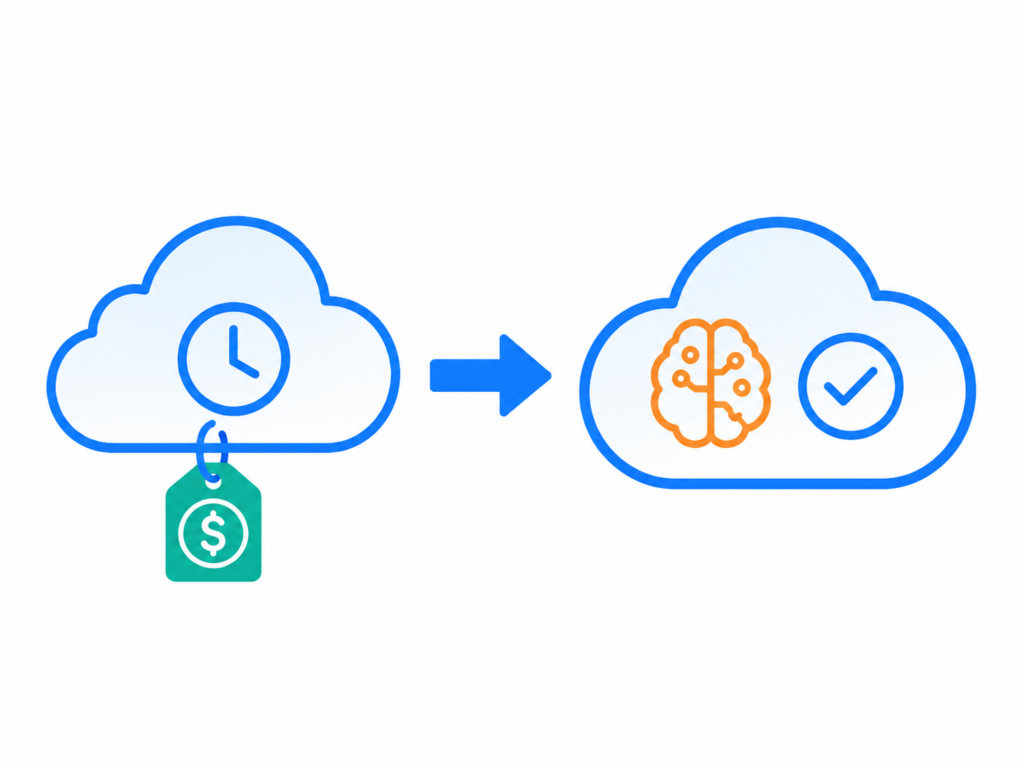
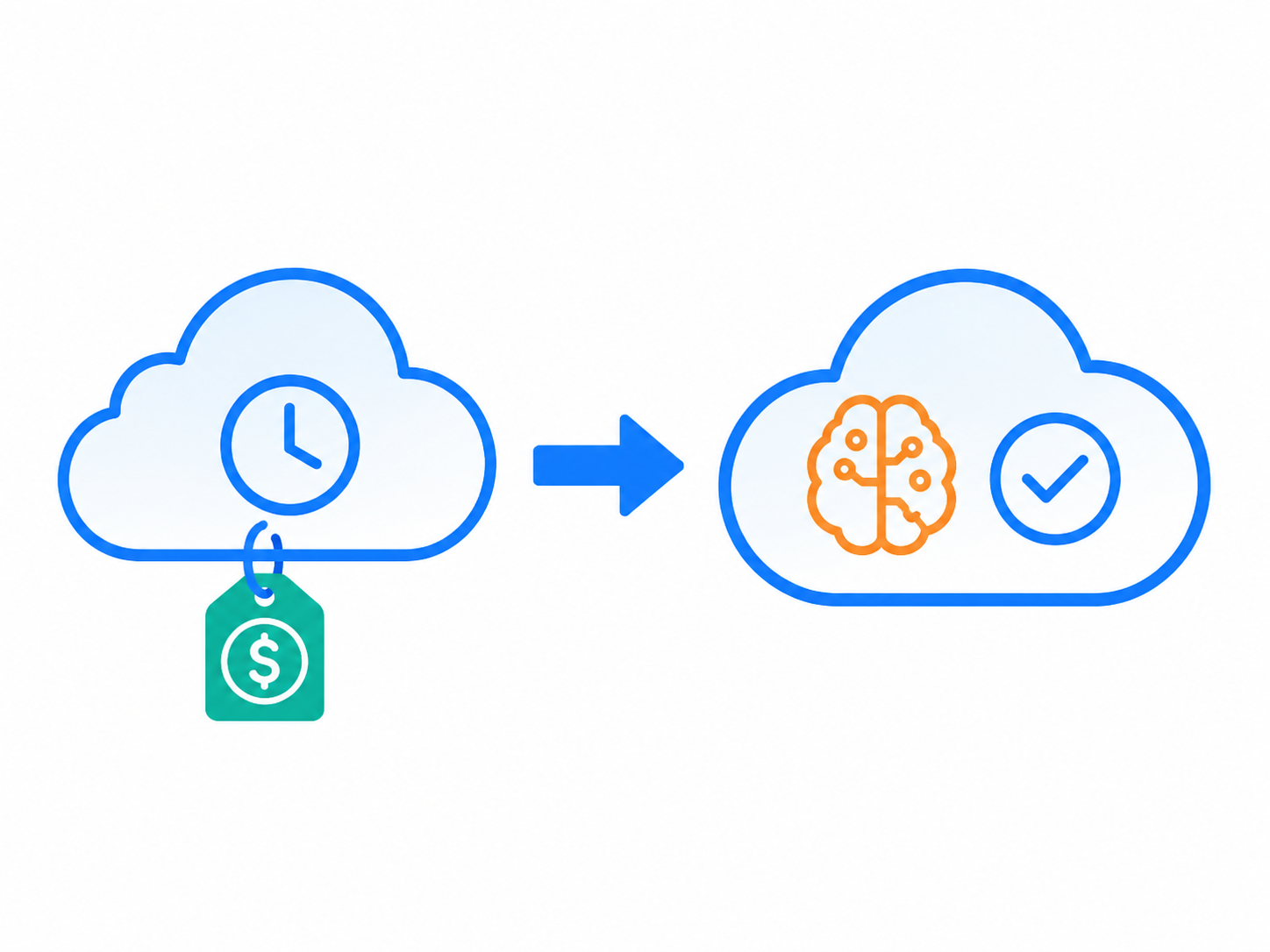
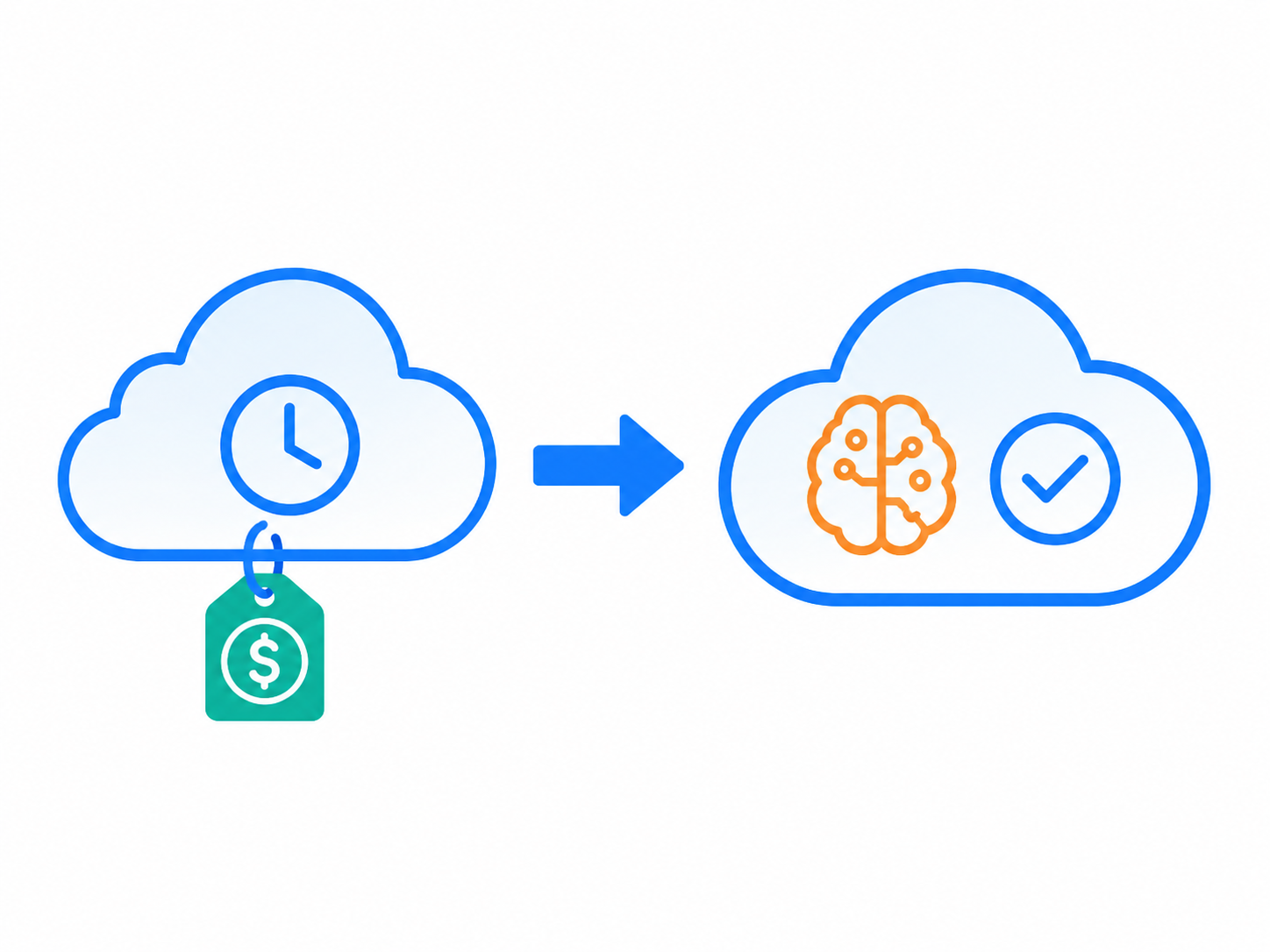
Increasingly, organizations are less interested in the precise number of warehouse seconds, CPU cycles, or tokens consumed than in the business outcome those resources produce.
Did the platform generate the required report?
Did it identify the anomaly?
Did it produce a reliable forecast?
Did the AI agent successfully complete the requested workflow?
These questions focus less on infrastructure consumption and more on business value.
If this trend continues, customer-facing pricing models may gradually evolve beyond charging exclusively for infrastructure resources. Providers may increasingly experiment with pricing models based on completed workflows, autonomous agents, successful predictions, analytical services, or other measurable business outcomes.
It is important to distinguish customer pricing from provider economics.
Even if customers eventually pay for completed business processes rather than infrastructure resources, cloud providers will continue optimizing the underlying consumption of CPUs, memory, storage, networking, and energy. Infrastructure economics do not disappear simply because customer pricing becomes more outcome-oriented.
The commercial abstraction changes.
The underlying engineering does not.
There Is No Universal Winner
Throughout this article, no attempt has been made to identify a universally superior pricing model.
Such a model almost certainly does not exist.
Consumption-based pricing provides remarkable flexibility and allows infrastructure costs to follow business activity closely. Capacity-based pricing offers stable operating costs and simplifies financial planning. Reserved capacity, subscriptions, workload-based billing, and consumption models each solve different business problems.
The current cloud market reflects this reality.
Rather than replacing one pricing philosophy with another, major providers increasingly offer multiple commercial models because their customers optimize different objectives.
Some organizations value elasticity.
Others value predictability.
Many require both.
The continued coexistence of these pricing models suggests that cloud providers themselves recognize that no single commercial model satisfies every workload or every business.
Conclusion
Discussions about cloud platforms traditionally focus on technology.
We compare performance.
Scalability.
Security.
SQL capabilities.
AI features.
Migration complexity.
These remain important considerations.
This article has argued that another dimension deserves equal attention.
Pricing models are not merely billing mechanisms.
They are business models.
They influence budgeting, governance, operational processes, architectural decisions, and ultimately the economics of an entire analytical platform.
Cloud computing has introduced not only new technologies but also new forms of dependency.
Technical lock-in remains highly relevant.
Pricing lock-in deserves similar consideration.
An application may remain technically unchanged for years while its financial characteristics change significantly because the provider evolves its commercial model. The recent evolution of AI pricing from relatively simple subscriptions toward increasingly consumption-based token models demonstrates that pricing philosophies continue to evolve alongside technology.
History suggests that this evolution will continue.
The mobile phone industry moved from increasingly sophisticated tariffs toward flat-rate subscriptions as customer priorities changed.
Cloud computing simultaneously explores increasingly granular consumption models and increasingly sophisticated capacity-based offerings.
Artificial intelligence may ultimately reshape the discussion once again by transforming compute from a resource primarily consumed by humans into one continuously utilized by autonomous systems.
Whether future pricing models are based on warehouse runtime, individual queries, AI agents, completed workflows, or entirely new commercial concepts remains impossible to predict.
One conclusion, however, appears increasingly difficult to ignore.
Organizations evaluating strategic cloud platforms should consider not only how easily applications can be migrated between technologies, but also how deeply their business becomes coupled to the provider’s pricing philosophy.
Vendor lock-in has traditionally been viewed as a technical challenge.
The next decade may demonstrate that it is equally an economic one.
Written by Roland Wenzlofsky, founder of DWHPro and author of Teradata Query Performance Tuning. DWHPro has helped data warehouse practitioners for 15+ years.
Related Services
⚡ Need Help Optimizing Your Data Platform?
We cut data platform costs by 30–60% without hardware changes. 25+ years of hands-on tuning experience.
Explore Our Services →📋 Considering a Move From Teradata?
Get a personalized migration roadmap in 2 minutes. We have migrated billions of rows from Teradata to Snowflake, Databricks, and more.
Free Migration Assessment →